
Medley's Approach
MEDLEY with AI

MEDLEY with AI
Guided by its mission to shape the future of healthcare, Medley is implementing AI and other technologies to address the challenges facing the healthcare sector.
Today, in addition to the growing need to secure human resources in medical and nursing care, healthcare providers are under increasing pressure to improve operational efficiency and productivity. However, in clinical settings, the adoption of technology has not progressed sufficiently due to institutional frameworks, regulatory constraints, and long-established practices. As a result, administrative work in non-clinical domains has continued to expand, leading to long working hours and increased burdens on healthcare professionals.
At the same time, advances in AI technology are opening up new possibilities for medical providers as well as for patients and individuals. By applying AI to parts of work that have traditionally relied heavily on manual effort, productivity can be improved and the workload of healthcare professionals can be reduced. This also helps create more time for engaging with patients, enabling the delivery of higher-quality healthcare. Innovation in this field is expected to continue, and the market for AI in healthcare is projected to grow to approximately JPY 1.5 trillion by 2035.
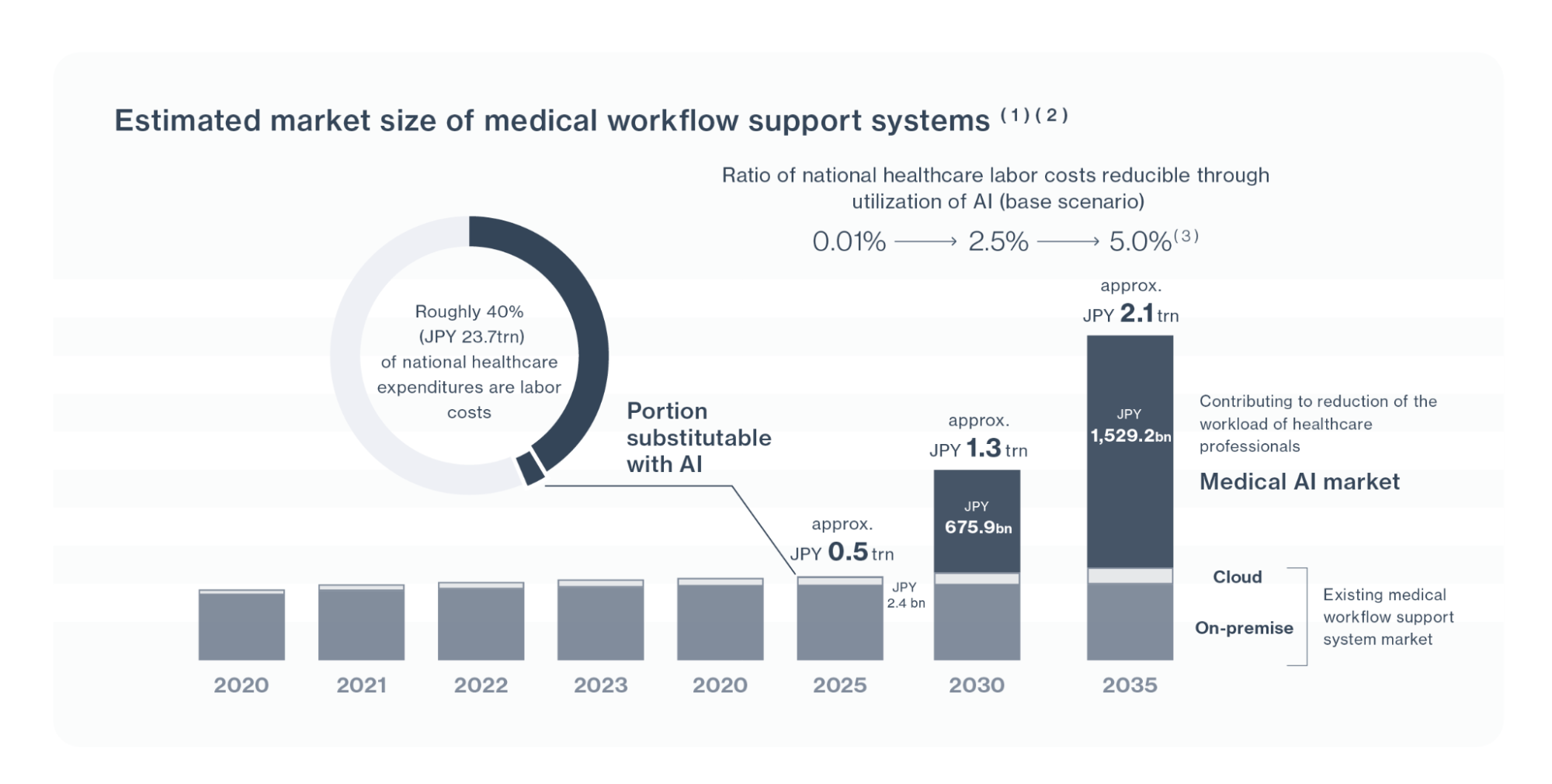
(1) The size of medical AI market is calculated based on our company's estimation of personnel expenses using data from the Ministry of Health, Labour and Welfare's "Future Outlook for Medical Expenses," "Overview of National Medical Expenses for FY2022," and "The 24th Survey on the Actual Conditions of Medical Economics (Survey on Medical Institutions, etc.)," assuming that productivity improvement support of 0.01%, 2.5%, and 5% is possible.
(2) Existing medical workflow support system market reference: Fuji Keizai Co., Ltd., 2022 Current Status and Future Prospects of the Medical Collaboration and Medical Platform-Related Market
(3) We have set the ratio of costs reducible through utilization of AI at 5% based on the fact that data from the MHLWʼs Monthly Labour Survey shows that overtime pay accounts for 5% of total cash earnings among workers in the medical and welfare sector, and that the MHLWʼs Reform Plan for Medical and Welfare Services sets a goal of improving service output in this sector by 5% (and 7% for physicians) by 2040
In light of the potential of this market, Medley's approach to AI places priority not on basic technology research, but on the development of products and features that can be put to practical use in real-world settings such as medical institutions. Through these efforts, we are working to improve operational efficiency in non-clinical domains while helping to deliver better healthcare experiences. Across a wide range of areas, we are steadily implementing AI-driven functions, including capabilities that automatically transcribe and summarize conversations during medical consultations; tools that support pharmacists in providing medication guidance and creating medication histories; assistance with the creation of various medical documents; and solutions that improve efficiency in operations related to recruitment and training.
We also believe that the appropriate use of AI can do more than improve operational efficiency at medical institutions—it can contribute directly to improving the quality of healthcare itself. To make this possible, we must first become an organization that uses AI naturally and effectively in our own work. With the goal of becoming an "AI for ALL" organization—one in which all roles routinely leverage AI across all areas of work—we are developing internal guidelines and promoting AI utilization tailored to specific roles and operational contexts.
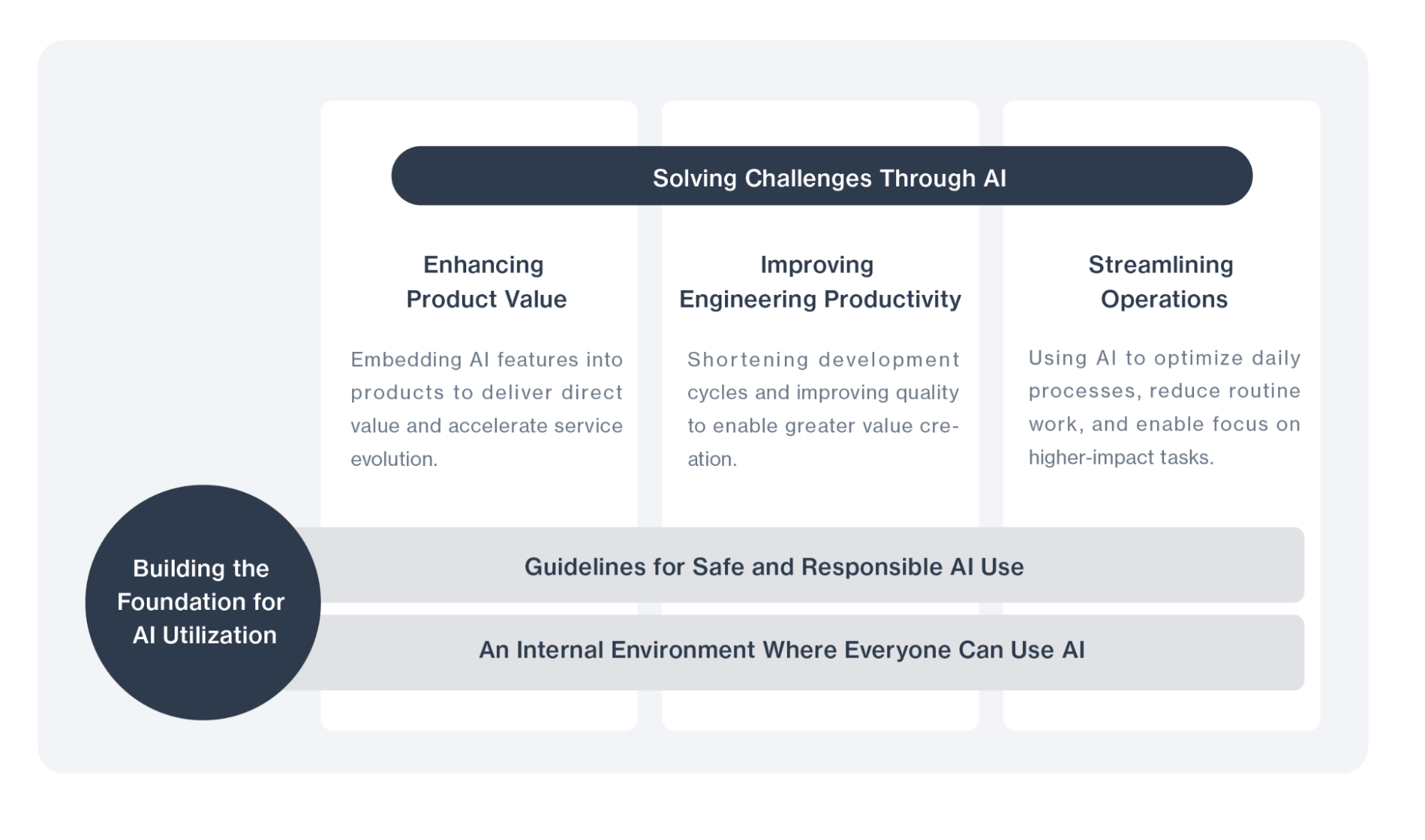
Solving Challenges Through AI
Embedding AI into Products
To reduce the burden of non-clinical work for healthcare professionals and create more time for patient care, Medley is advancing its MEDLEY AI CLOUD initiatives. Through this platform, we connect hospitals, clinics, dental practices, pharmacies, and patients and individuals through data, and provide AI-powered functions such as electronic medical records, medication history management, and the automatic summarization of clinical notes.
In addition, to support the recruitment, development, and retention of healthcare professionals, we apply AI to improve the efficiency of recruitment processes and to support the design of training and education programs.
Improving Engineering Productivity
Within Medley's engineering organization, AI is used to shorten development cycles and improve quality. Through coding assistance and test automation, we enhance both development speed and reliability, building an environment that enables teams to create greater value.
Streamlining Operations
Across the entire organization, we use AI to optimize day-to-day operational processes.
By improving interfaces such as UI and UX, we create smoother workflows and environments that are intuitive and easy for everyone to use. At the same time, we standardize and enhance operational procedures through AI, ensuring consistency and quality. By reducing the time spent on routine work and enabling teams to focus on more creative and higher value-added tasks, we achieve both increased productivity and a higher quality of work.
Building the Foundation for AI Utilization
Establishing AI Guidelines
As a company that handles sensitive information in the healthcare domain, security and the protection of privacy are our highest priorities. We have established internal AI guidelines and promote the use of AI in a manner that ensures transparency, accountability, and safety.
Creating an AI-Enabling Internal Environment
To promote organization-wide AI utilization, we have built a secure environment that allows the safe use of tools and platforms such as ChatGPT, Dify, n8n, and Gemini.
Informed by the latest technological trends, we evaluate both effectiveness and safety before introducing and sharing these tools. Through regular study sessions, employees are able to flexibly test and apply a wide range of models and workflows. This lowers technical barriers and enables everyone to leverage AI as part of their daily work.